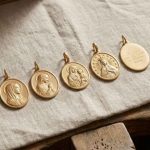
If you have spent any time in Catholic circles, you already know the feeling. Everyone seems to have one: the same oval medal, the same rays around Mary’s hands, the same inscription. It is a beautiful piece and its history matters, but for a lot of people it no longer feels personal. If you want something still Marian, but genuinely something different, the good news is that Marian iconography is far richer than one apparition. Here are seven alternatives that keep the devotion intact while giving you a design you rarely see on someone else’s neck.
TL;DR – Resume
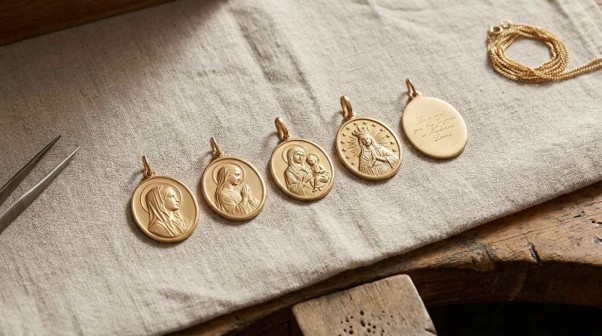
- Vierge au Voile: quiet, veiled Madonna, understated everyday piece
- Vierge Priante: Mary at prayer, contemplative and simple
- Notre Dame de Paris: a French cultural and spiritual double meaning
- Vierge Tendresse Maternelle: Madonna and Child, warm and intimate
- Vierge Regina: Mary as Queen, a more formal statement piece
- Vierge Couronnée d’Étoiles: the Woman of the Apocalypse, bold and rare
- Mater Purissima: Latin inscription, minimalist and refined
All seven come from Sanctis’s Marian medal collection, a French workshop that has focused exclusively on christening and religious jewelry since 1959.
Comparing the 7 alternatives
| Medal | Symbolism | Best for |
| Vierge au Voile | Modesty, quiet faith | Everyday wear |
| Vierge Priante | Prayer, humility | A first personal medal |
| Notre Dame de Paris | Marian devotion tied to French heritage | Gifts with a cultural layer |
| Vierge Tendresse Maternelle | Motherhood, tenderness | Baby gifts, new mothers |
| Vierge Regina | Mary as Queen of Heaven | Confirmation, formal occasions |
| Vierge Couronnée d’Étoiles | The Woman of Revelation 12 | Confirmation, a bolder statement |
| Mater Purissima | Purity, restraint | Minimalist tastes |
1. Vierge au Voile: the quiet alternative
The Vierge au Voile shows Mary with her head covered, eyes lowered, no rays, no serpent underfoot, none of the visual drama of the Miraculous Medal. It is a design built on restraint rather than narrative, which is exactly what makes it read as something different on a chain.

Sanctis produces it in gold and offers free engraving on the reverse, so it works equally well as a first medal or as a quiet upgrade from one you already own.
Best for: someone who wants a Marian piece that does not announce itself.
2. Vierge Priante: Mary at prayer
Where the Miraculous Medal shows Mary distributing grace outward, the Vierge Priante shows her turned inward, hands joined, head bowed. It is one of the oldest ways to depict her and one of the least represented in mainstream christening catalogs today, which gives it a genuinely rare feel despite being a classic motif.
Best for: a contemplative gift, particularly for a confirmation or a personal devotion piece rather than a baby gift.
3. Notre Dame de Paris: a medal with two meanings
This is one of the more unexpected options on the list. Notre Dame de Paris carries both a Marian meaning and a French cultural one, referencing the cathedral itself rather than a specific apparition. For a French family, or for anyone with a tie to Paris, it adds a layer of significance you will not get from any of the standard apparition medals. You can find angel-themed christening medals that carry a similar dual meaning, protective and cultural at once, if this direction interests you.
Best for: gifts tied to French identity or heritage, not only religious devotion.
4. Vierge Tendresse Maternelle: Madonna and Child

If the appeal of Mary is her motherhood rather than her apparitions, the Vierge Tendresse Maternelle puts the Christ Child directly in the frame, in an intimate embrace rather than a formal pose. It is a strong choice for a baby’s christening precisely because the imagery mirrors the occasion: a mother and her newborn.
Best for: birth and christening gifts where motherhood is the emotional center of the piece.
5. Vierge Regina: Mary as Queen
The Vierge Regina depicts Mary in her role as Queen of Heaven, a more formal and hierarchical image than the tender or contemplative options above. It suits a communion or confirmation better than a birth gift, since the symbolism leans toward maturity and coronation rather than infancy.

Best for: confirmation gifts or anyone who wants a more formal, statement-making Marian piece.
6. Vierge Couronnée d’Étoiles: the boldest choice
This is the design most likely to genuinely surprise someone who thought they had seen every Marian medal. The Vierge Couronnée d’Étoiles depicts Mary crowned with twelve stars, drawn directly from the Book of Revelation’s description of the Woman clothed with the sun, the moon under her feet, and a crown of twelve stars. It is Marian, biblical, and visually unlike anything in the standard christening catalog, which makes it the strongest option if what you are really after is unique.
Best for: someone who wants a Marian medal that reads as deliberate and unusual rather than default.
7. Mater Purissima: purity in Latin
The Mater Purissima medal keeps the imagery simple and pairs it with a Latin inscription, « purest mother. » Where several of the other options lean toward ornament or narrative, this one leans toward restraint and language. If you liked exploring the difference between a medal and a bracelet charm for a minimalist gift, this medal follows the same instinct applied to iconography rather than form.
Best for: minimalist tastes and anyone who values the inscription as much as the image.
How to choose based on your profile
If you want the least « seen » option: the Vierge Couronnée d’Étoiles or Notre Dame de Paris will feel the most distinct, since almost no one recognizes them on sight.
If the medal is a birth or christening gift: the Vierge Tendresse Maternelle speaks directly to the occasion through the Madonna and Child imagery.
If you are choosing for a teenager or confirmation: the Vierge Regina or Vierge Couronnée d’Étoiles both carry more maturity than the softer maternal designs.
If you simply want a quieter alternative to the medal everyone owns: the Vierge au Voile or Vierge Priante give you the same devotional weight without the visual signature everyone recognizes. For more direction on choosing a christening symbol for a daughter specifically, it is worth comparing a few Marian options side by side before deciding.
Still Marian, simply different
If you want to stay within Marian devotion but move away from the medal everyone already wears, start with what draws you in: motherhood, prayer, coronation, or scripture. The Vierge Tendresse Maternelle and Vierge Priante keep things soft and personal. The Vierge Couronnée d’Étoiles and Notre Dame de Paris go furthest from the familiar. Whichever direction fits, the point is the same: there is no rule that says Marian devotion has to look like everyone else’s.
Frequently asked questions
What makes a Marian medal different from the Miraculous Medal?
The Miraculous Medal is one specific apparition design among dozens of Marian representations. It depicts Mary at Rue du Bac in Paris in 1830, with rays streaming from her hands and a serpent underfoot. Every medal on this list is still a depiction of the Virgin Mary, just drawn from a different apparition, a different biblical passage, or a different artistic tradition, so the devotion stays the same even as the imagery changes.
Is a medal like the Vierge Couronnée d’Étoiles still considered devotional?
Yes, it draws directly from a New Testament passage. The Woman clothed with the sun, crowned with twelve stars, comes from the Book of Revelation and has long been associated with Marian imagery in Catholic tradition. Choosing this design over the Miraculous Medal does not step outside Marian devotion, it simply draws on a different scriptural source.
Can these medals be engraved for a christening or communion?
Yes, engraving is available on the reverse of Sanctis medals. A first name, a date, or a short inscription can be added at no extra cost, which is standard practice across the collection. This makes any of the seven alternatives just as personalizable as a Miraculous Medal for a christening or communion gift.
What materials are these Marian medals made from?
Most of the designs above are produced in 18 carat gold, with some also available in silver. Sanctis manufactures all of its medals in its own workshop in Saumur, France, and finishes vary between polished and satin depending on the model. If a specific metal or finish matters to you, it is worth checking availability per design before ordering.
How do I choose the right Marian medal design?
Start with the occasion and the tone you want, not just the image itself. A birth gift calls for something maternal, like the Tendresse Maternelle. A confirmation calls for something more formal, like the Regina or the Couronnée d’Étoiles. If you simply want to move away from the medal everyone already owns, the quieter Voile or Priante designs offer that without changing the underlying devotion.